

Why Do Off the Shoulder Sleeves Move or Restrict Your Arms?
When off the shoulder sleeves move or limit your reach, check how they connect to the bodice. Raise one arm gently and watch what moves first. A sleeve that pulls the neckline upward points to a different problem from a sleeve that pinches while the bodice stays in place. Do not force the sleeve down. If ordinary reaching repeatedly displaces the neckline, choose a different construction or ask a tailor whether that specific connection can be altered.
There is no universal arm angle that every off-the-shoulder dress should allow. A useful decision depends on the design and your plans: can you reach for a glass, greet someone, put on your coat, and move comfortably without repeatedly resetting the neckline? This guide focuses on those practical requirements. It does not promise that a specific fabric, grip strip, or sleeve shape will solve every movement problem.
SHOP THE LOOK: Every Love Song Green Off-The-Shoulder Ruffle Maxi Dress
Identify How the Off the Shoulder Sleeves Are Attached
A shared neckline or band
Look at the garment off your body first. Is the sleeve part of a continuous band running across the chest and around the arms? Does the same folded edge continue into the sleeve? Note where the material joins without pulling it apart. When you try it on, observe whether arm movement also moves that shared edge. This identifies the part of the construction to discuss if the neckline rises more than you want.
A visible elastic edge does not tell you how comfortable the complete garment will be. Check the actual product description, then test its behavior gently. Do not stretch the edge to its limit or assume it will permanently loosen into the right fit. If the garment feels restrictive in ordinary use, preserve its condition while you consider an exchange or professional assessment. Wearing it painfully is not a useful way to evaluate a hoped-for future fit.
Sleeves attached at individual points
Some designs have decorative sleeves or draped pieces attached at separate points. Identify those connections and look for the first point that moves when you reach. Does a sleeve pull on the side of the bodice? Does a decorative loop tighten around the upper arm? Keep the movement within a comfortable range. A tailor or the retailer needs to know which attachment is involved before suggesting an adjustment; the overall neckline label is not enough.
Straps supporting a separate shoulder detail
If the dress has visible straps as well as an off-shoulder element, distinguish their roles by checking the listing and inspecting the garment. Do not assume the decorative piece can be detached or that the straps are removable. Test the outfit as supplied. If the straps are designed to adjust, make only a small change and watch the bodice. Record whether the upper fit improves or merely transfers the pulling to another area.
SHOP THE LOOK: Simply Irresistible Blue Off Shoulder Ruched Cape Sleeve Maxi Dress
Use a Movement Map to Locate the Problem
| What changes first | What to check next | Avoid doing |
|---|---|---|
| The shared neckline rises when an arm lifts | Sleeve connection and the required reach | Forcing the neckline downward |
| The upper sleeve pinches while the bodice stays still | Sleeve opening and upper-arm room | Stretching it forcefully |
| The bodice slides before the sleeve moves | Bodice fit and support arrangement | Tightening only the sleeve |
| Only one arm is restricted | Local attachment, twisted layer, or asymmetric detail | Assuming both sides need the same alteration |
| Movement works until a coat or bag is added | Outer layer or bag placement | Changing the dress before testing the accessory |
Start with your arms relaxed. Reach forward at a comfortable height as though picking up a glass. Return to the starting position and note whether the garment settles on its own. Next, bring your hands together in front of you as if greeting a friend. Finally, try the highest reach you actually expect at the event, stopping before pain or strain. Observe the neckline after each separate action instead of repeatedly pulling it back into place.
Describe the outcome in useful terms. “The sleeve pulls the front neckline upward when I reach across the table” is specific. “It is impossible to move” does not identify the activity or the moving part. A short video can show the sequence to a fitting professional. Keep the camera private and use only the detail needed to explain the garment behavior. You do not need to share personal fitting images publicly to get practical advice.
Avoid testing an irrelevant extreme movement just to make the dress fail. Equally, do not omit an ordinary action you know you will need. If you are attending a lively dance party, a dress that only works with your elbows held close to your sides may be the wrong choice for that event. If you are planning a quiet seated dinner, reaching comfortably at the table remains a reasonable requirement.
SHOP THE LOOK: Made to Shine Yellow Off Shoulder Ruched Maxi Dress
Separate a Sizing Issue From a Design Trade-Off
When comparing sizes is useful
Compare sizes when the sleeve opening or bodice feels too tight and the product measurements suggest you need more room. Use the same movements and underlayers for both versions. Notice whether the larger option improves the restricted area while keeping the neckline where you want it. If the extra room makes the bodice slide, record the result honestly. You may need different proportions or a different construction rather than another size in the same style.
Sunfere's size page states that its general chart describes body measurements, while actual clothing dimensions should be checked in the product measurements. That distinction matters when you are trying to assess a sleeve opening or another garment detail not resolved by the general size label.
Ask the retailer about an unavailable sleeve measurement before ordering a second size. Explain where you need room and which product you are considering. Do not invent an allowance by adding a fixed number to your arm measurement without knowing how the garment is intended to fit. If the answer remains unclear, choose a style whose relevant dimensions or fit can be assessed before the event rather than assuming the next size will solve the problem.
When changing the construction makes more sense
If the fit feels comfortable at rest but a required movement consistently pulls the shared neckline, ask whether the design can accommodate that activity. Do not frame the situation as a personal failure to wear it correctly. You can keep the exposed-shoulder look while comparing another construction. A separate draped shoulder detail, an adjustable strapped style, or a different neckline may give you a more useful option, but each still needs its own movement check.
Sunfere's one-shoulder dresses can serve as a comparison when you want an asymmetric shoulder line instead of a band across both arms. Check movement on both sides and inspect the upper fit before deciding. A new silhouette changes the design question; it does not remove the need to evaluate the actual garment. Choose the one that meets your activity requirements, not the one that makes the strongest comfort promise in a category description.
SHOP THE LOOK: A Night To Remember One Shoulder Rhinestone Trim Maxi Dress
Decide What Can Be Adjusted Without Damaging the Dress
Use only adjustments the garment is designed to offer
Use a supplied slider, tie, or fastening according to the product instructions. Do not cut a joining stitch because it looks temporary, or pull out elastic to gain room. Photograph the construction and ask what the connection does. If the retailer cannot confirm a built-in adjustment, treat it as a tailoring question. Keep tags and packaging intact as required by the applicable return policy while you make that decision.
For a dress that otherwise works, a professional fitting may identify a limited alteration. Ask the tailor to demonstrate the proposed result and explain its effect on the neckline. Would changing the sleeve attachment leave a visible mark? Would adding room require extra fabric? Would the adjustment change coverage or the drape you bought the dress for? These questions help you evaluate the proposal without assuming that every restrictive design can be converted into a free-moving one.
Do not turn a support problem into an adhesive problem
A grip strip or fashion tape should not be treated as proof that a garment will remain stable. If the bodice shifts substantially, investigate fit first. If you choose a skin-contact accessory for a minor coverage preference, follow its directions and check compatibility with the garment. Stop using it if irritation occurs. Do not use stronger adhesive, extra tape, or tighter elastic to hold a painful arrangement in place.
Avoid improvised loops around the upper arms, exposed safety pins, or other restraints intended to force sleeves down. A workaround that blocks necessary movement defeats the purpose of the fitting. If the dress only works while something physically holds your arms in a narrow position, choose a different construction for an active occasion. Keep the alteration discussion focused on the garment, not on restricting how you move through the evening.
SHOP THE LOOK: In My Feelings Off Shoulder Ruched Top & Skirt Set
Choose the Dress Around the Work Your Arms Will Do
Dinner and cocktail receptions
For a seated dinner, reach toward a place setting, lift a glass, and move the chair while wearing the dress. Watch whether these ordinary actions pull the neckline beyond your preferred coverage. A dress that needs resetting after every reach is a poor choice for that dinner, even if the sleeves look correct while your arms are still.
Dancing and celebrations with frequent photographs
If dancing is important, try the motions you enjoy while wearing the intended shoes. You do not need to reproduce a full routine. Identify whether ordinary turns and arm movements are comfortable and whether the bodice returns to its starting position. For group photographs, consider whether you will want to place an arm around someone. If a common action is impractical, make that a selection criterion instead of hoping the problem becomes less noticeable at the event.
Hosting, carrying items, and travel
If you are hosting, include serving and clearing in the try-on. A restrictive band around both upper arms may interfere with carrying a tray even when eating is comfortable. Choose a construction that permits those tasks or change into the occasion dress after preparation. Do not carry hot dishes in a garment that prevents comfortable movement.
Also practice putting on your coat without pulling on the shoulder trim. Check that the coat opening accommodates the sleeve shape and that removing it does not drag the neckline out of position. Use a bag arrangement that leaves the shoulder detail undisturbed. If a different outer layer solves the issue, keep that specific pairing together. The dress and its supporting pieces need to work as a complete outfit, not as separate photographs.
SHOP THE LOOK: Adorable Impression Yellow Off Shoulder Draped Mini Dress
Keep, Alter, or Change the Style
Keep the dress if it meets the movement and coverage requirements you identified and remains comfortable in its intended position. Consider alteration only when the proposed change is demonstrated and the person doing the work can explain the construction limits. Choose another style if required reaching remains restricted, the bodice repeatedly shifts, or the solution depends on forcing the sleeves into place. These are practical selection boundaries, not judgments about whether an off-shoulder look suits you.
Take front and side photos of the dress at rest and during the movement that causes trouble. Show the tailor where the sleeve connects and whether the neckline moves with it. Ask what the proposed alteration would change about support and coverage. If those changes would compromise the fit you want, select a different upper construction.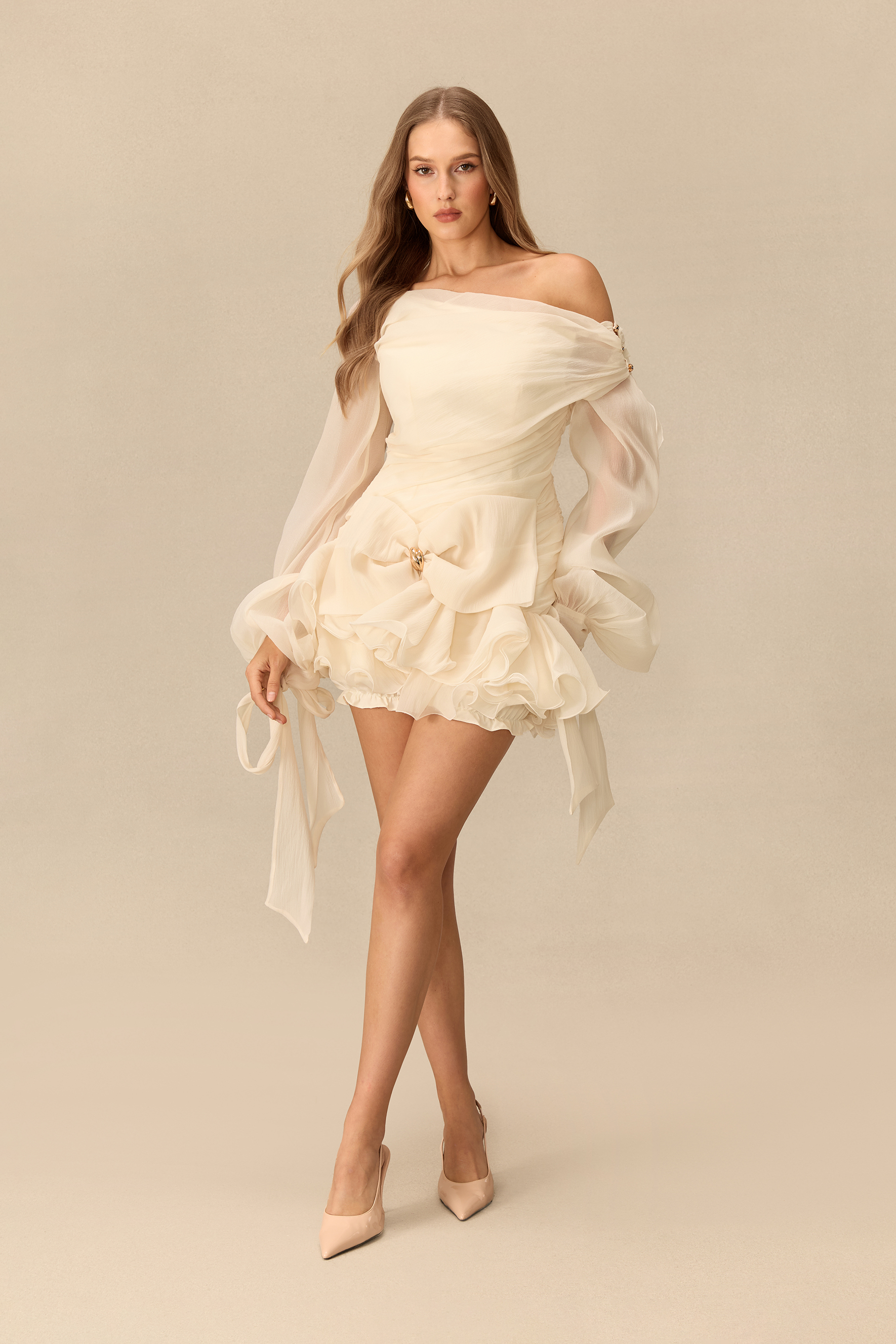
SHOP THE LOOK: In A Fairytale Off Shoulder Ruffle Mini Dress
Frequently Asked Questions
Are off-the-shoulder dresses supposed to restrict your arms?
Some designs involve a movement trade-off, but pain or inability to perform necessary activities is a reason to reconsider the fit or style. Judge the actual construction and your event needs.
Should I pull the sleeves farther down to stop them rising?
Do not force them below their intended position. If they immediately move back when you reach, assess the attachment and fit rather than repeatedly pulling harder.
Will sizing up solve tight sleeves?
Sizing up may help tight sleeves when the measurements support a larger size, but check the bodice too. More sleeve room is not a complete solution if the neckline becomes unstable.
Can a tailor detach the sleeves?
A tailor may be able to detach the sleeves after assessing their connection to the bodice. Ask about support, coverage, visible marks, and whether the finished design will still work as intended.
Is a one-shoulder dress automatically easier to move in?
No. It is a different construction to compare. Test both sides of the specific garment and the activities you expect to perform.